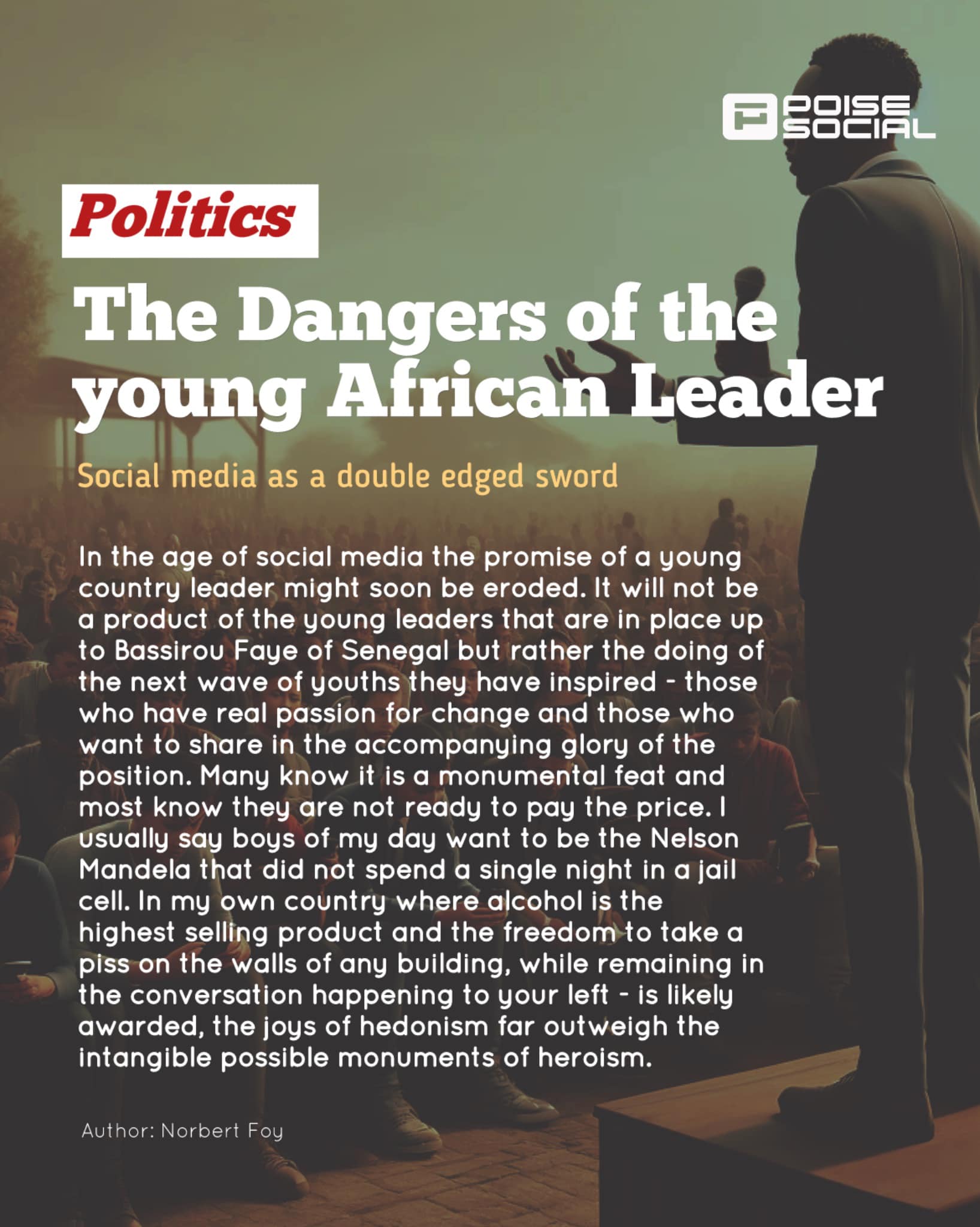
In the age of social media, the promise of a young country leader might soon be eroded. It will not be a product of the young leaders that are in place up to Bassirou Faye of Senegal but rather the doing of the next wave of youths they have inspired – those who have real passion for change and those who want to share in the accompanying glory of the position. Many know it is a monumental feat and most know they are not ready to pay the price. I usually say boys of my day want to be the Nelson Mandela that did not spend a single night in a jail cell. In my own country where alcohol is the highest selling product and the freedom to take a piss on the walls of any building, while remaining in the conversation happening to your left is likely awarded, the joys of hedonism far outweigh the intangible possible monuments of heroism.
I therefore doubt that more than a few too many will stick their heads out to dare the hare to the race for the top job. There will be a few serious ones but I fear many might seize the opportunity to get a payday from social media attention. Those many, I believe, will undermine the intentions of the genuine few – making it harder for them to get the required support. It will be a self imposed divide and conquer scenario. God forbid it actually becomes a tactic used by the old guard to erase the promise of youth. The potential for social media to serve as a double-edged sword—providing a platform for visibility and mobilization, while also fostering divisions and undermining the seriousness of political engagement—underscores the complexity of modern political leadership.
In Cameroon, we are currently seeing how the manipulation of youthful ambitions by established political figures can undermine genuine efforts for reform. Samuel Eto’o ran on youthful energy and change and he is being set up to appear incompetent. His case is different because he rose to fame pre social media. I’m more worried about the young people who would see this wave as a means of gaining popularity even with no real desire to run the country nor a compelling vision and the required tenacity to endure the hardship and realities of political activism. A good performance could earn quite the social media following for one to become a sought after influencer. None of us are strangers to attention prostitution in our country.
Unfortunately even the good and the bad need attention but the algorithm favors who it wants badly. I write this article after coming across two young people who have announced their candidacy for the next presidential elections (2025). The one with the most engagement on social media is the one I find to be an imposter. That’s my worry. They have both declared they are going in as independent candidates. Chapter III, Section 121, line 2 of Cameroon’s electoral code rules that one can run as an independent candidate, on condition that they are put forward by at least 300 (three hundred) dignitaries hailing from all the regions, with 30 signatures from each region. Persons who qualify to append such signatures shall be either Members of Parliament or of Trade Chambers, or regional councilors, municipal councilors, or first class chiefs. A dignitary can only append their signature to one candidate.
These stipulations of Cameroon’s electoral code for independent candidates highlight the systemic barriers to entry for new political actors. The requirement for support from a broad cross-section of dignitaries across regions underscores the importance of networking and coalition-building but also raises questions about the accessibility of the political arena for outsiders, especially those who may not have traditional political or familial ties to leverage. Overcoming this hurdle might be the first sign of success for these candidates who for good reason do not want to integrate any of the political parties. With over 200 registered political parties in Cameroon, getting another one authorized by the regime in place given the current circumstances can even serve to discredit the creators of the party who might easily be tagged as agents of the divide and conquer system.
While the enthusiasm of young Africans to engage in political leadership is a positive sign, the path to effective leadership is fraught with challenges that require a nuanced understanding of both the opportunities and pitfalls presented by modern technology and traditional political structures. The success of this new generation of leaders will depend on their ability to marshal the resources and support necessary to overcome these challenges while maintaining a commitment to genuine service and transformation. But as was the case in Senegal, the power does not lie in the hands of the presidential hopefuls but rather in the youths who want change.
The antidote to this potential poison is youth political engagement beyond social media commentary. Youths can safeguard their hopes and aspirations from being undermined by imposters by fostering a culture of critical engagement and informed decision-making. This involves conducting thorough research on candidates’ backgrounds, alliances, ideas, and track records of activism, rather than relying solely on social media narratives or charismatic public personas. Young people have to be intentional and diligent without rampant skepticism. In fact, the change they want is not going to come on the back of another social media cruise. That social media cruise might actually be the reason why that change doesn’t come.