

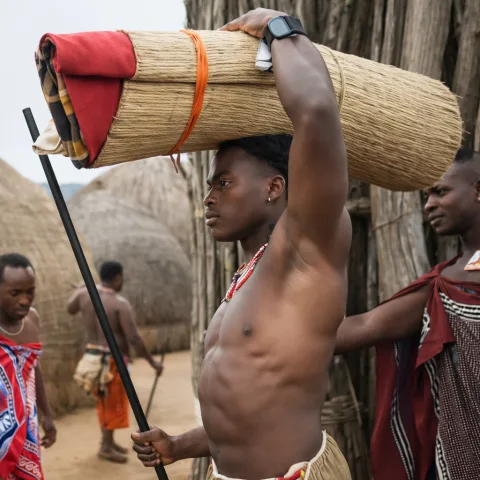
Early this week, I read an opinion piece on Facebook attributed to The Zimbabwe Times. It examined the ongoing African tour by US-based streamer IShowSpeed, framing it as yet another example of America’s uncanny ability to make money out of “nothing.” The article argued that the tour’s viral moments were not accidental but carefully choreographed, orchestrated by invisible hands pulling strategic strings behind the scenes.
In late December 2025, the 20-year-old livestreamer launched an ambitious continental project, Speed Does Africa: a 28-day journey across roughly 20 African countries. The tour has already included Angola, South Africa, Mozambique, Eswatini, Botswana, Zimbabwe, Zambia, Rwanda, Kenya, and Egypt. Through real-time livestreams, Speed has showcased street life, landscapes, food, humor, and public moments to millions of viewers worldwide, turning digital attention into global visibility.
If Speed’s tour is a textbook case of how Americans monetize attention, then ours is the textbook case of how we miss golden opportunities and barely notice them at all.
As clips from his streams flooded my feed, a thought nagged at me: what if this level of planning, coordination, and narrative control were present in Cameroon’s tourism sector? The contrast between Speed’s viral digital storytelling, now a dominant force in global tourism, and our national tourism narrative is stark.
First, let us be honest: we had a chance, but we missed it.
Cameroon is home to nearly 930 officially recognized tourist sites, ranging from savannas and beaches to rainforests and living cultural traditions. Yet tourism’s contribution to GDP remains modest. Estimates from the Ministry of Tourism place the total contribution (direct and indirect) at about 4.1% of GDP, supporting roughly 15% of jobs.
International tourism receipts tell an even bleaker story: approximately USD 681 million in 2019, about 1.7% of GDP, fell to USD 437 million in 2020 due to the pandemic. In the best of times, Cameroon attracts roughly one million international visitors annually. That figure is not tragic because it is small; it is tragic because it is unnecessary.
Compare this to Bali, a destination over 80 times smaller in land area that welcomes more than six million international tourists a year and generates billions in revenue. Bali did not stumble into success. It invested, marketed consistently, and built a narrative people want to step into. Cameroon, by contrast, often waits for trends and then tries to hijack them – arriving late and half-prepared.
Across Africa, governments and agencies understood what Speed represented. They didn’t host him because the trip was cheap. They hosted him because attention is currency. Visibility compounds. Presence creates leverage. Cameroon’s tourism custodians didn’t plug into that moment. Il est l’enfant de qui même? Except this time, the child came with a global audience eager to discover Africa. We let the moment pass.
But even if we had seized it, were we ready?
On my way home, I once stood in a painfully long immigration line at the airport. After hours of waiting, someone shouted that at least non-Cameroonians should be let through so people wouldn’t think this was our standard. An officer sneered back: “They are already here, where will they go?” Laughter followed. It was meant as a joke. It wasn’t funny.
Now imagine, for a moment, that Speed had landed in Douala or Yaoundé with his crew. Of course, he would have been fast-tracked. No beer requests. No delays. Then the content would begin: beaches in Limbe and Kribi, rainforest hikes in Campo-Ma’an, cultural moments in Bamenda, and community life in Fotokol in the Far North. The whole itinerary.
The world would have loved it.
He might have visited the Ekom Nkam Waterfalls, where scenes from The Legend of Tarzan were filmed, or the slave-trade village of Bimbia. Brands would have found ways to “accidentally” place themselves in the frame. Cameroon would have been trending.
But beneath the beauty, cracks would show.
A sector rich in assets yet modest in output. Infrastructure that struggles to meet basic global expectations. We are talking about airports with unreliable Wi-Fi, difficult road networks, and inconsistent accommodations. A marketing presence that barely hints at what could be world-class.
In short, we would have sold potential rather than performance.
Here is the hard truth: potential has never been enough.
Why do sites such as Dja Faunal Reserve and Lobéké National Park, both UNESCO World Heritage sites, struggle to sustain tourism growth? Why are beach towns like Kribi and landmarks like Mount Fako so poorly marketed globally?
Because tourism does not run on slogans. It runs on systems.
Recycling ministers, unveiling logos, and launching plans without continuity will not fix structural failures. What we need is a ruthless rethink: infrastructure that works, digital connectivity that welcomes, professional marketing that tells a coherent story, and partnerships that ensure tourism benefits extend beyond city centers.
In the new age of tourism, narratives travel faster than airplanes. Countries that understand this design experiences before visitors arrive. Cameroon still improvises after visitors land.
If the Africa Cup of Nations taught us nothing, will it take a 20-year-old Twitch streamer to finally make the lesson stick?
Everything today may be “planned,” but in Cameroon, too often, plans stay on paper while opportunity moves on without us. We are too old, too experienced as a country, to keep missing moments this big.
We have the culture.We have the geography.We have the story.
What we lack is a system that turns all of that into a lived experience, an economic engine, and a global brand.