

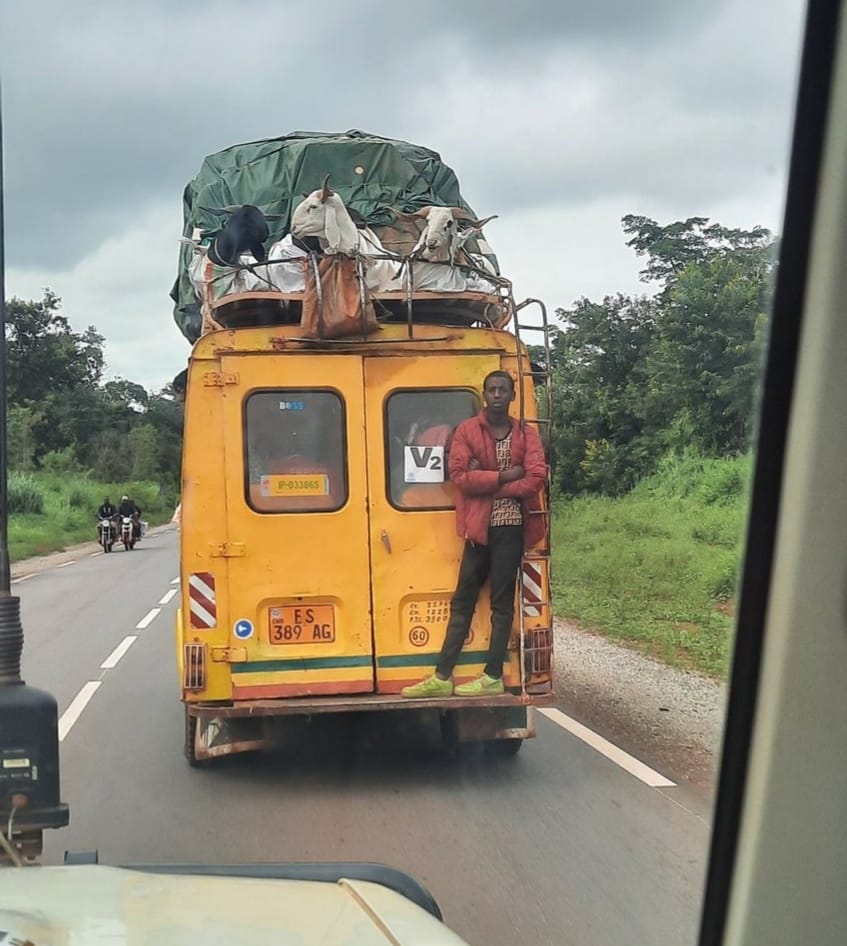
When I first moved to Yaounde in 2010, one of the things that caught my attention was the state of the buses that plied the Biyem Assi - Mokolo route. These buses sometimes lined up around Biyem Assi Ecole and would pick up passengers going towards Mokolo. They were usually very old and stooping with their paint peeling off and their tires having a toxic relationship with friction.
The one thing that caught my attention most was the driver's attendant - the motorboy as we call it here - who, when the bus was full, had to hang on to the metal ladder at the back of the bus.
I remember one day in particular. I was sitting in a taxi behind one of such buses and the motorboy was just a child; he could not have been more than 13 or 14 years old. The bus was full, already on it's way to Mokolo and the boy hung on to the ladder at the back and the small iron platform on which his legs lay bounced uncertainly with every pothole the driver got into.
My heart filled instantly with a number of emotions that went from empathy to seeing a child having to be in such a position, to rage at the driver for making him be in that position. I imagined myself at his age being in school, everything given to me and never thinking I could be in that place with hopelessness written all over my face. It was a difficult sight to bear
A trip to Mokolo at the time cost 200frs. I could not understand why the driver would not forfeit 200frs so that boy could not be in the death trap that was the back of the bus. Was 200frs worth all the risks that boy faced in that position?
I asked the taxi driver that question and he shrugged, no doubt anaesthesised by the number of times he had seen that postcard. Maybe at some point he had cared and then he had seen it so much that he had told himself, perhaps, caring was not really going to change anything.
This picture above was captured on the Batouri-Bertoua road and posted to Twitter. When I saw the picture I was reminded of that little boy from years ago. I'm no kinetic physicists, but it seems like the goats in the overhead rack are in a more secure position (?). This is a highway and it is more dangerous. And compared to the Mokolo trip which took about 25 minutes from Mendong, the boys on these roads in the East region can hang on to that ladder for 3 hours - Come rain, come sun. Come wind, come air.
The bus fare for every passenger in that bus probably costs about 2000frs or more. In today's cameroon, 2,000frs goes a long way. But what is 2,000frs compared to the safety and the comfort of your own work companion? Someone who actively helps you earn a living. A child, no less, who is a mere victim of bad governance we all suffer in this country? A child who should be in school and not have to worry about being in that position
We do not love ourselves
W.W
Photo: Abanda Christian