
Tino often jokes that when President Paul Biya finally leaves office, the National Assembly will have to pass a special budget just to remove his portrait from every public building in Cameroon. Any proud Cameroonian knows that photograph — the one from the 1980s, where a younger Biya smiles kindly into the future. It hangs in offices, classrooms, bars, and even living rooms, its knowing smile visible in every corner like a watchful spirit.
Curiously, that portrait remains the only thing perfectly preserved through the decades. The image has withstood time, decay, and irony. Not a single wrinkle appears on the face of the man in the frame, even as the country he leads ages into disrepair. What some once saw as a smile of optimism now feels like a warning — the grin of endurance itself.
Ministers and civil servants treat the photograph as a symbol of their legitimacy. In official photos, they stand proudly beneath it. Some even move the frame from the wall to the couch so it appears behind them during TV interviews — as if being close to that eternal smile proves loyalty or skill. The image falsely suggests that Cameroon is a prosperous, harmonious country led by a caring patriarch.
Yet the walls where that portrait hangs are both literally and figuratively falling apart. In the regime’s mythology, the photograph keeps the walls up; in reality, it is a charm against collapse — a totem to hide the cracks.
The portrait is not alone. Cameroon has perfected the art of the empty symbol: Emergence 2035, Cameroon of Great Ambitions, Les Grandes Réalisations, One and Indivisible, Rigour, Integrity, and Moralisation. Each slogan was launched with fanfare, but none rooted in philosophy, measurable purpose, or accountability. They are incantations designed to mask inertia.
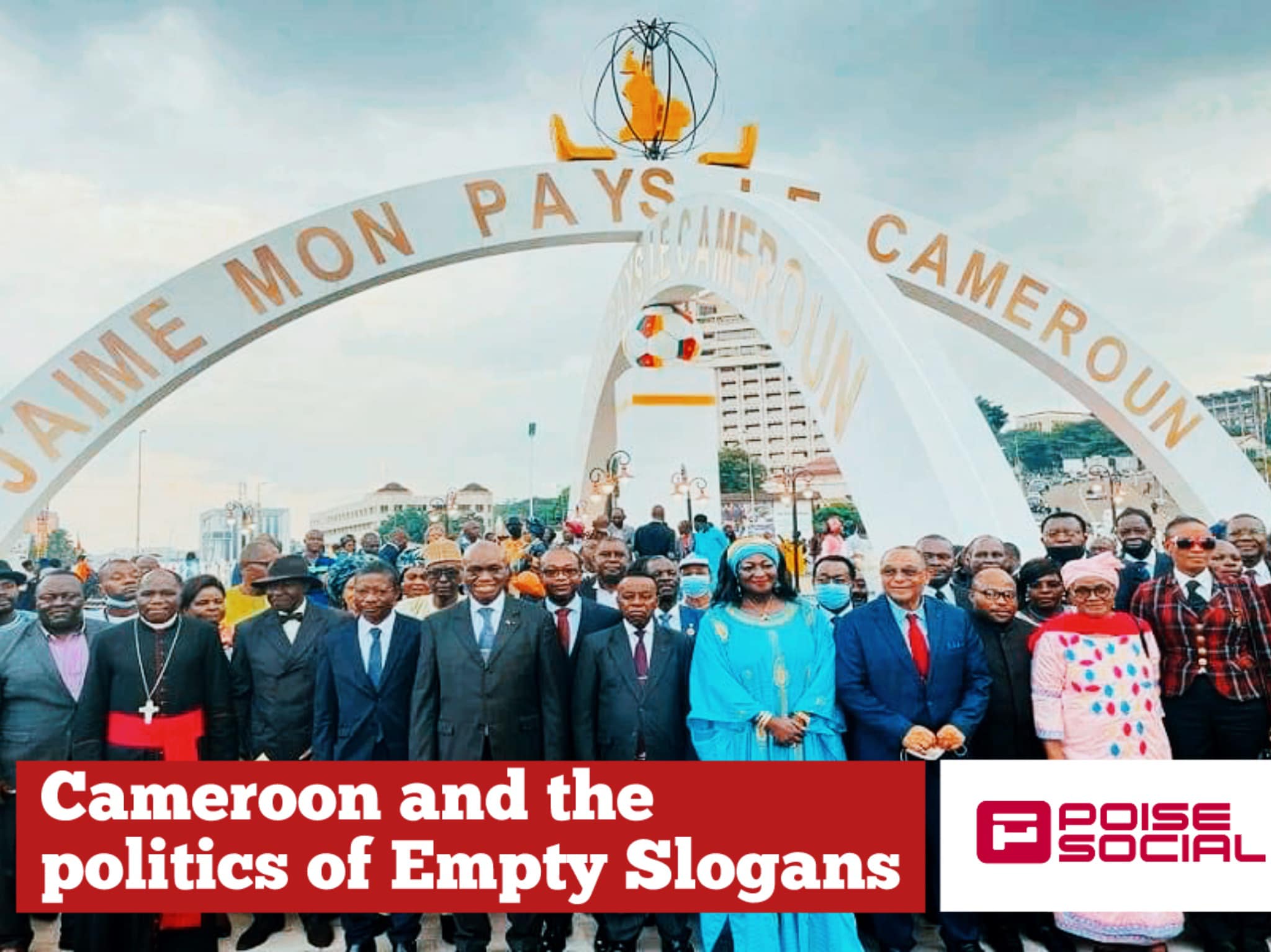
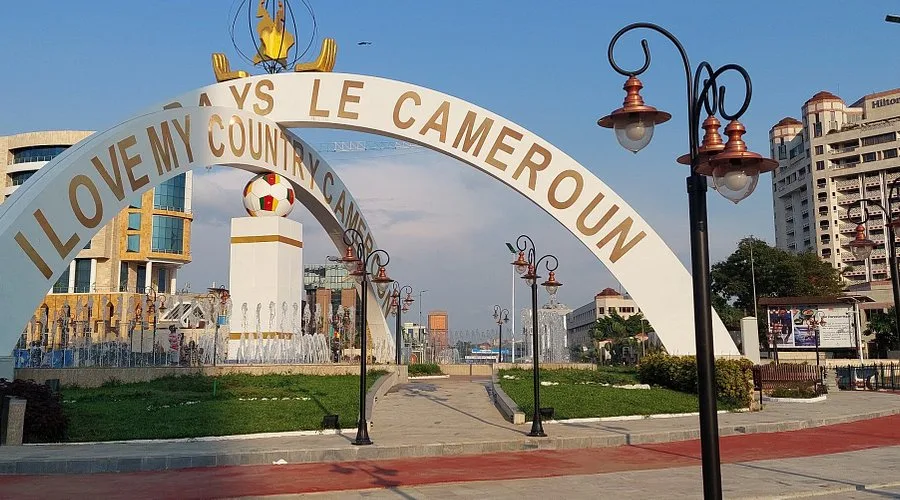
The newest addition to this gallery of absurdity is the monument at Carrefour J’aime Mon Pays — a concrete show of love for a country from which many are eager to escape. It serves as both sculpture and satire. In typical Cameroonian style, people have responded with humor, turning pain into parody. But laughter doesn’t heal despair.
How can a government that neglects its citizens expect affection from them? The monument is an empty promise cast in concrete — another illusion in a nation built on such illusions.
Even the global success of Francis Ngannou, now celebrated as a national hero, is reduced to a hollow symbol of pride. The government conveniently forgets that Ngannou had to cross the Sahara Desert illegally, risking death, to find opportunities elsewhere. For every Ngannou who survives, dozens perish — their bodies swallowed by the desert or the sea. Yet their struggle is rebranded as proof of Cameroonian resilience.
The pedestal Ngannou’s image now stands on isn’t made of steel mined through transparency and good governance. It is carved from the decaying wood of corruption, impunity, and years of misrule.
Even the once-esteemed doctrine of Rigour, Integrity, and Moralisation — which at least provided a philosophical anchor — has long been buried under layers of cynicism. It collects dust in archives, while the portrait symbolizing it still stands, timeless and unaffected.
Symbols, at their core, aim to unify a people, evoke memory and meaning — to turn collective purpose into actual progress. Elsewhere, leaders use them, sometimes cynically, but often supported by real policy results. The rhetoric may be manipulative, but the roads are built, the schools open, and the lights stay on.
In Cameroon, symbolism has taken over substance completely. We exist in a stage of slogans, each louder and more hollow than the previous one.
Think about the yearly parade themes for International Women’s Day, Labour Day, or Youth Day. They’re long-winded riddles no one really reads, strings of bureaucratic poetry meant just to fill a banner. The longer the slogan, the more it pretends to have meaning. By the time it’s translated into the other official language, even the original confusion is lost in translation.
Nobody cares what these phrases mean. The task is mechanical: pick a trending word, connect it to “solidarity,” “emergence,” or “patriotism,” print it on glossy paper, and declare victory.
This is what Cameroon has become — a nation of lofty dreams and lowered expectations. We chant goals we know will never be achieved, shifting deadlines to infinity: 2000, 2020, now 2035. Each new slogan demands fresh faith, and each failure is quietly forgotten.
The most disheartening thing is that it’s the poorest and most vulnerable who cling to these hollow promises. Can we really blame them? When every day is a struggle for survival, slogans become the lullabies of endurance. Hope is rationed like bread.
So here we are, a nation that craves love but seldom gives it; a place where the only unchanging thing is a portrait that remains forever young and a chorus of slogans that never deliver.
Cameroon is, indeed, one and indivisible — but only in its disillusionment.