

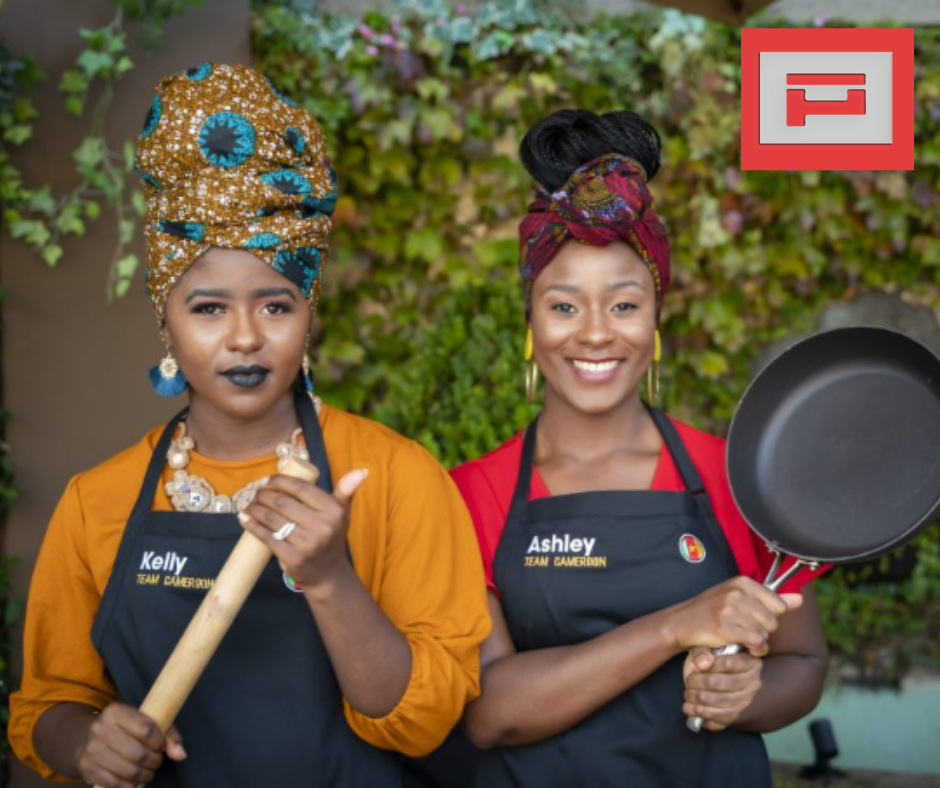
The two ladies you see in the picture are Kelly Cynthia Vola and Ashley Vola. They are two Cameroonian sisters who immigrated into Australia 15 years ago. The two sisters are taking part in a reality TV show on an Australian TV network. The show, called “Plate of Origin” is a competitive reality cooking show that has been dubbed ‘the world cup of cooking.’
The competition has 10 teams representing 10 different countries. Cameroon is the only African country in the competition and it is represented by Kelly, 26 and Ashley, 28. In the show’s recent episode, Cameroon was pitted against Vietnam and emerged the winner of the round after seducing the three judges with a plate of Jellof rice served with chicken, fried plantains, and a small bowl of pepper.
If there is something Cameroon can claim bragging rights to, it is obviously our cuisine. Ask any Cameroonian who has traveled across Africa and they will tell you that our cuisine is unmatched. Ask any foreigner who has visited Cameroon – I mean, really visited Cameroon, and they will tell you that what impressed them most is our cuisine and how good and varied it is.
I remember when one of my elderly aunts died back in 2009, one of her daughters who had spent over 10 years in Nigeria came to Cameroon for the burial, accompanied by her Nigerian friend. That lady spent her time eating and gushing at how good and varied our food was. I have never seen someone enjoy food that much and it was both funny and heart-warming to watch.
I remember her being marveled at the taste of eru, and ndole and nangtare. I remember her eating egusi pudding and miyondo and saying that she wished she could stay in Cameroon for a whole month just so she could eat more food she would not have the chance to eat.
That was the first time I actually realised that we have great food in this country.
As someone who has seen it all on Twitter, one of the most interesting and funny things I have witnessed is how Cameroonians have rebuked Nigerians, Senegalese, Sierra Leoneans, and Ghanaians when they have tried to drag us into the “Jollof” wars.
Cameroonians constantly remind them that Jellof rice is a cheap meal we eat when broke, and which we serve to kids and uninvited guests at parties. In the process, we brag about our food and dare anyone to come to Cameroon and taste for themselves.
Unfortunately, this has not been used to promote tourism. A great opportunity for branding Cameroon as the food capital of Africa is being missed. Whose fault is it? Without a doubt, the government’s. Cameroonians have done their part by reminding foreigners on every communication platform that they can get on to, that our food is the best. But they can only do so much. The office of tourism in this country, it would seem, has no idea what nation branding is.
For years, we have been pushing the slogan “Africa in Miniature” to describe the tourism potential in Cameroon. That in itself is not a bad thing. If you look at in intrinsically, it makes sense, we have a semi-desert area, a savannah region, a grassland region, an equatorial rainforest, a wetland, a coastal area, lakes, waterfalls, highlands, and the tallest mountain in west and central Africa, with its own peculiar ecosystem. All the climates in Africa are actually found in Cameroon. We happen to have all of these, unlike many countries. That is just one good argument for touting ourselves as ‘Africa in Miniature’.
But HOW is that being communicated? That is where the biggest problems lie. Like everything in this country, we are fond of vapid slogans that have no clear roadmap, no defined objectives, no communication, and no federation of people around the idea. And you know many of them – Emergence 2035, Le Cameroun de grandes ambitions, Le Cameroun de grandes realisations. I am sure you can add others.
And it will not just be enough to call Cameroon the Food Capital of Africa. We will have to put in the work. Ghana for example used the “Year of the Return” campaign in 2019 to mark the 400th year of the start of the slave trade. The initiative was to encourage the sons and daughters of former slaves in the Americas and Caribbean to return to Africa and not just get in contact with their roots but also to see how they can invest in the continent, and in Ghana in particular.
But before that happened, Ghana had been putting in work to fight corruption and to significantly improve the business and social climate in the country. They even did a great marketing push by welcoming the AfroNation music festival in Accra that year.
The result, Ghana gained a massive PR in black and prominent media outlets in the west and many American celebrities visited the country in December 2019 – Idris Elba, Michael Jai White, Diggy Simmons, Cardi B, T.I, Ludacris, Akon, Rick Ross, Jidenna, Anthony Anderson, Naomi Campbell, Steve Harvey. Some, like Charlamagne Tha God, even bought a house there.
What Kelly and Ashley are doing for Cameroonian would have gained a massive boost if our government had thought of pushing Cameroonian cuisine as one of it the nation’s brand’s peculiarities. Unfortunately, they are not doing so, and so we are left to rebuking Nigerians on Twitter and thanking the two Cameroonian sisters in Australia for giving our cuisine a much-needed visibility.
- Wandji Wilfred.
Follow us on Twitter: @PoiseSocial #PlateOfOriginAU #Cameroon #CameroonianCuisine #NationBranding