

I recently learned that although the world's largest producer of cashews is Côte d’Ivoire, the world's largest exporter of cashews is Vietnam.
Vietnam is making a fortune. Côte d’Ivoire is not.This is a story of successful globalization and failed industrialization.
In 2022, Vietnam exported $791m of cashews to the EU and $885m to the US.
Meanwhile, Côte d’Ivoire exported just $85m to the EU and $41m to the US.
But Côte d’Ivoire is the much bigger producer, with a crop yield of ~800k tonnes, compared to Vietnam's ~400k tonnes.
So where are all the Ivorian cashews going?
They are mostly going to Vietnam!
The value of cashew exports from Côte d’Ivoire to Vietnam will reach $1bn this year, accounting for around 80% of the trade between the two countries.
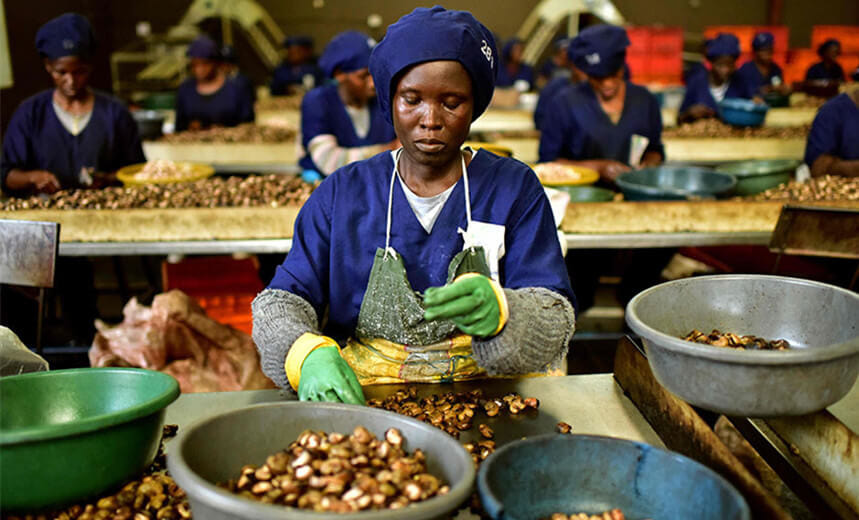
The reason for this is that Vietnam has become the world's second largest cashew processor. Raw cashews are shelled and roasted in Vietnam for domestic consumption and for export.
Vietnamese processing facilities meet food safety standards set by the EU and US. By contrast, Côte d’Ivoire has failed to develop a processing industry.
The World Bank estimates that "only 7% of the processing is done in Côte d’Ivoire." Raw nuts in the shell "are exported to India or Vietnam for further value adding activities."
So much untapped value.
What does this all mean for consumers?
Let's say you go to a supermarket to buy a bag of cashews.
You look on the pack and you see "product of Vietnam," as is the case for the 365 brand cashews from Whole Foods. There is a good chance the cashews you bought were harvested in Côte d’Ivoire and shipped 10,500 nautical miles over two weeks to Vietnam.
Once processed, the cashews were then shipped 17,000 nautical miles over a month to the US.
The nuts literally went around the world.
This is probably the most price efficient way of meeting European and American demand for cashews today, but it is not economically beneficial for Côte d’Ivoire nor is it environmentally sound.
Things should be different.
Côte d’Ivoire exported ~$16bn of goods in 2022.
Vietnam's export total was *20 times* greater at ~$334bn.
Let's say that Côte d’Ivoire was able to gain just half of Vietnam's cashew export share in the EU and US and let's keep demand unchanged. The ~$800m boost in Côte d’Ivoire's exports would represent a 5% increase in total exports, whereas the loss of $800m in exports to Vietnam would be just a 0.2% decrease in Vietnam's overall exports.
Such a shift would make Côte d’Ivoire richer without making Vietnam poorer.
What the cashew story suggests is that the new discourse about deglobalization, derisking, friendshoring etc. is overshadowing the real opportunity of this moment.
Global supply chains can be retooled and redesigned in ways that help distribute prosperity more equitably.
Maybe we can say that the globalization of the last few decades was too focused on supply chains (creating welfare for the consumer with the best price) when it should have been focused more on value chains (creating welfare for the producer with the best wage).
It's useful to think about cashews because most countries can't produce them, no matter how much they might want to "deglobalize."
Some goods will still need to be imported from far away and that's ok...
...so long as countries don't also import an undue share of the value.
Copied from a Twitter thread made by @yarbatman