

For most children of the 80s like me, makossa music always plays in the background of some of our most cherished memories. I grew up listening to my grandmother playing it in the house, in the bus on my way to school, at school “ballets,” and during the infamous chair dance competitions at birthday parties. Today, unfortunately (as far as I’m concerned) our kids won’t have that playing in the background.
Yes, I know. It cannot be the same music, because it is obviously a different generation growing up in a different era. What I think they will be missing is the authenticity we had in our era.
The internet and satellite TV may have brought many positive things in our lives but we have to also acknowledge that it has chiseled away a huge chunk of what and who we are as a people musically. Mostly, it has affected the many young people who are today the most visible elements of Cameroon’s music. As much as I love the urban music we have today and the way our distinctive version of Afropop has taken over Francophone Africa, I can’t help but feel a little itch deep in my entrails when I think that that genre of music isn’t really us.
Of course, there are elements of our traditional music from Bikutsi to Assiko in it, but sometimes I feel it is more “hippity hoppity” than it is Cameroonian.
It’s not hard to see that out of all the traditional Cameroonian music that has gone mainstream, Makossa has suffered the most. And it’s sad, because Makossa is THE music that opened Cameroon culturally to Africa. There is something referred to as “l’ecole de la basse Camerounise.” This is a reference to the cream of some of the best bass guitarist that got noticed in Europe, notably in France. It is an ode to how well the Cameroonian music scene produced excellent bass guitarists.
The peculiarity of this ‘ecole’ is that it is almost exclusively made of Makossa artistes – Vicky Edimo, Etienne Mbappe, Richard Bona, Jean Dikotto Mandengue, Toto Guillaume, Ntumba Minka and even Bisou Bass & Kotto Bass. Almost of all them self-taught! To me, it’s not out of some coincidence.
Makossa (from the 70s and the 80s in particular) had this nobility and purity and the music carried you away irrespective of whether or not you understood the lyrics. These people put in work and love and passion into the art form. Some of the famous names of Makossa today have been around for a long time in the background, learning the genre. If you listen to ‘Miango’ by Manulo, a song released in the very early 80s, you can distinctly hear Grace Decca’s signature voice singing backup. She was a teenager then.
I look around me today and it pains that I don’t see anyone from our generation (35 and below) that is really carrying makossa in its otherwise pure form or something quite close to it. By “pure” form I would reference a song like Toto Guillaume’s “Francoise” as an example. I know they are out there, they are really not just mainstream and may never be. Please don’t mention Charlotte Dipanda who is an obvious example.
And I’m not laying blame on the Salatiels or Phil Bills. I find it admirable how much they do put elements of traditional Cameroonian music into their compositions already. And also, although the right to sing Makossa music is not reserved to the Duala people (Bebe Manga was Bayangi), you kind of want to look into that direction and ask what happened. It certainly goes more than pointing a finger at Petit Pays, whom I personally commend for popularising the genre and whom I personally blame too for watering it down, but also by looking at the whole picture from an anthropological, cultural and societal-change perspective to understand the dynamics that answer the question asking what happened.
But as it stands, it is evident that things are not the same. Thank God for the likes of Ben Decca who, till today, are still giving us some of that good makossa. But after he and the others of his generation are gone, what happens? Will that sound be lost? I know Ytube will be there to archive it for us but are we ever going to go back to it?
I’m somewhat comforted by the fact that life is like a wheel. There is a cycle in almost everything and trends always somehow come back. In fashion, for example, it is not uncommon to see fashion trends come back 15 years after they disappeared. I want to hope good Makossa from 70s right into the early 90s will come back. Other times I have this feeling of dread that it may not happen and with every great Makossa act passing on, that feeling grows stronger.
They have played their part and in have left the ball in our court. How we plan to play it is what makes me scared.
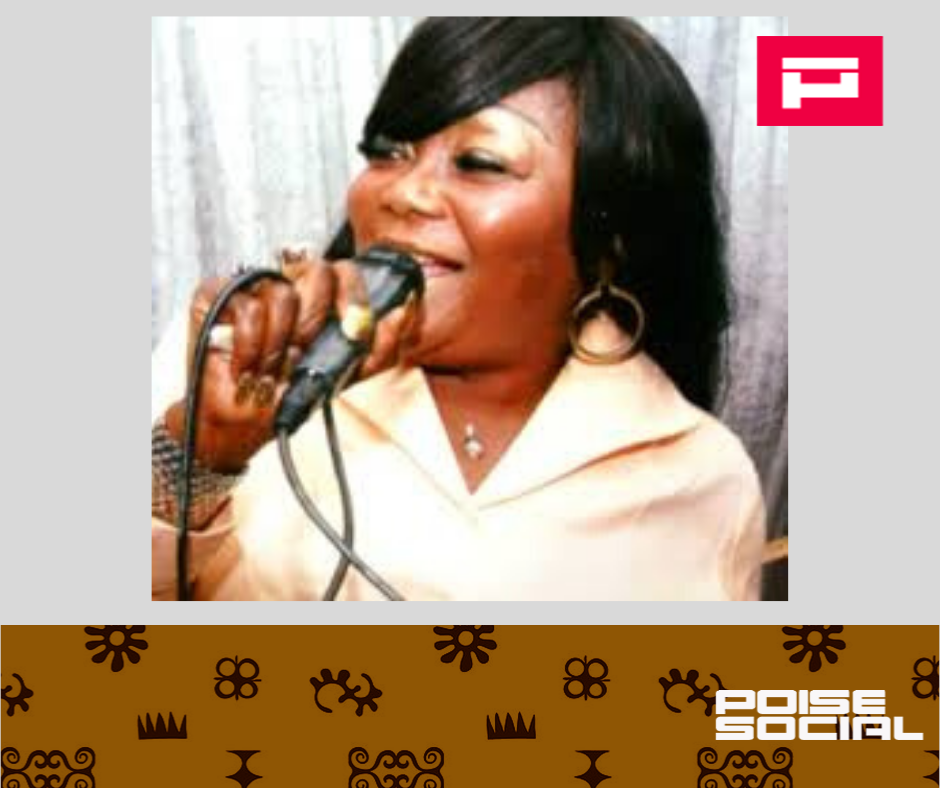
And as Nguea Laroute travels Lethewards to meet the others like Geo Masso, Tom Yoms, Charlotte Mbango, Axel Mouna and Hoigen Ekwalla who have gone before her, I’m certain she can pay the boatman in the currency that is the musical heritage that he lseft for us, the younger generation. Are we going to pay in that same currency or in a different one?
That’s a question for posterity.
Or perhaps, I am just being overly nostalgic and not in touch with the times. One thing I know for certain is that I feel a disturbance in the force fields of Makossa.
- Wandji Wilfred
- P.S When I mentioned “Lethewards” in the article, I was talking about River Lethe. In Greek Mythology, it was the river via which the dead traveled into the afterlife. The dead had to pay the boatman in whose boat they traveled they traveled; and they were buried with coins they had to use to pay the boatman.
Hence my metaphorical use of Mama Nguea’s music as currency for passage into music heaven.
That’s for a little context.