

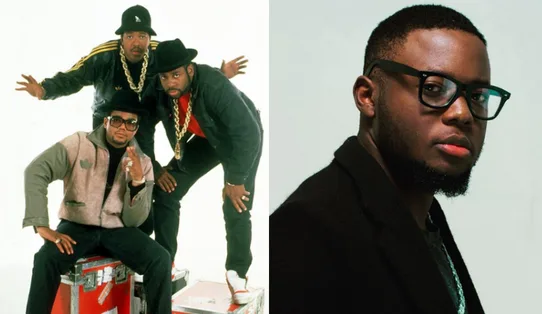
Run-DMC was hip-hop’s very first superstar and commercially successful music group. They burst onto the rap scene in 1983 and made the first major splash in hip-hop culture. Two things set them apart from other rappers or rap groups of the time: their music and their style.
Rap music at the time relied heavily on sampling. Rappers rapped on sampled portions of Disco, RnB and Funk music. Contrary to this general practice, the Run DMC guys relied solely on the Drum Machine. The drum machine came with sounds already loaded. They made their beats with that, and the beats had no guitars, violins, or pianos like sampled records. That immediately set them apart.
Secondly, many rap groups of the time were trying to break into the disco market. They performed at disco clubs and dressed like the R&B, disco, and funk stars of the time, in bedazzled leather jackets, leather trousers, and fur coats. The Run DMC guys did none of that. They dressed instead like everyday New Yorkers: jeans, trousers, sports jackets, bucket hats, and ADIDAS shoes.
They wore Adidas so much that their manager, Russell Simmons, realized they were actually making many people buy Adidas shoes. Many kids wanted to relate to them, so they bought Adidas shoes to emulate the RUN DMC look. Russell saw an opportunity and realized they had built enough clout in the market to get Adidas to sign a deal with them.
What he did next was very smart.
He made the group record a song titled ‘My Adidas’. He invited a representative from Adidas to a Run-DMC concert at Madison Square Garden, with over 20,000 people in attendance. At some point during the concert, the group members asked everyone in the audience wearing Adidas to hold up their Adidas. People took off their Adidas shoes and held them up. And then the beat of the song “My Adidas” dropped, and the crowd went wild, singing along. The Adidas rep was highly impressed, and Run-DMC secured a deal with Adidas after that.
It was the first time an athletic apparel company struck a deal with an entity unrelated to athletics. This deal set the tone for the current sneaker culture, and it also moulded an essential part of Adidas’ brand, which survives to this day- the Adidas X Hip-Hop component of its brand.
The greatest hip-hop partnership (Kanye West X Adidas = Yeezy) has its roots in these early beginnings.
In Cameroon, it appears Ko-C pulled a similar stunt. He released a song called “Chill” in June of 2021 and featured bottles of the beer that goes by the same name in the music video. Five months later, in November 2021, he was announced as the brand ambassador for the beer. I cannot say for a fact whether they struck a deal before the video was released or whether the deal was the result of the video. What I can say for sure is that the long 5-month gap between the video’s release and the brand collaboration’s announcement makes me think it went some way. But in the absence of clear information, let us not speculate. In any case, it is not exactly the point.
The point I want us to focus on is the environment in which we find ourselves. Particularly by looking at the musicians and asking how much clout they possess to pull off a RUN DMC move, and then by looking at our business environment and asking ourselves if it is even worth the trouble. Let us focus on hip-hop and, more generally, the urban music movement.
Beginning with the culture, one might first ask: What is Cameroon’s hip-hop culture about? It is a tough question to answer. Essentially, everything we have now that is supposed to be the culture beyond the music itself is imported. There is very little floating around as hip-hop culture that the audience can buy into, literally and figuratively. Even our most famous and recognized urban superstar has not created something that impactful that people can buy into. The Hein Pere T-shirts worked for a while, but many aspects of what he is about today he has copied. From the El Pelucho teddy bear to the Killmonger haircut. I could even mention the American accent, but that would be hitting below the belt.
Before Run-D.M.C made Adidas cool, Adidas shoes were already part of black culture. Just like PUMA sports shoes were part of black dressing and culture at the time. Black people were already wearing them daily. Run D.M.C actually just elevated these in the eyes of the people because they were superstars, and by virtue of that, gave Adidas a new, fresh look –creating something new and impactful from it.
And Adidas is a commodity. This means that people buying into Adidas’s coolness directly translates into money, as they pay for the product. It is exactly what is happening with the Yeezys today. We are all tapping into the coolness and the creative genius of Kanye West.
Beer is also a commodity. In fact, there is nothing that says commodity more than beer, soap, and matches. But it is too general. It is generally not centered on anything unless it has been specifically branded for and positioned in a certain market niche. In Cameroon, Mutzig is the only beer that caters to music. But its brand lacks the coolness, youth, and vibrancy of hip hop.
Chill beer has certainly not been marketed in that music niche, let alone hip-hop. Even if one begins to ask if Ko-C is a pure hip-hop artist, there is still no correlation. And yes, not all campaigns are meant to drive sales, but can Ko-C make young, Cameroonian urban music heads drink more Chill beer than they already do? That is a tough question, and I doubt that even the sales team at SABC can give a clear answer.
One way we can determine this is by checking whether a special Ko-C flavour of Chill beer is sold at a slightly higher price and whether sales are recorded.
As things stand, it would be easier for anyone in the hip-hop market to sell something already part of the culture. Fashion, of course, remains the best bet. Again, hip-hop fashion is largely imported, so the best bet is a local brand that caters to the buying power of current rap and Afropop consumers, and an ambassador who is willing and patient enough to grow with the brand.
The only other aspect of hip-hop culture that readily translates into contemporary brand marketing is the music itself. Either through concert tickets or the use of a catchphrase in a rap record or some other music genre. For example:- Stanley Enow’s “Tu Vas Lire L’heure” used by Source Du Pays, Reniss’ “Dans La Sauce” used by Orange, or Aveiro Djess’ “On Falla Le Nyama” used by the now-defunct YUP.
It is the Cameroonian industry standard to capitalize on these catchphrases and run a short outdoor or digital campaign. In the case of Orange and YUP, the originators of these catchphrases were not even called to the table.
This is because we operate in an ecosystem in which very few large brands are patient enough to invest in an artist over the long term with a clear growth strategy. Most brands employ the “who is hot now” strategy to select whom they want to work with. This also makes sense because, in the current entertainment industry, music is usually the primary driver of market relevance. One cannot invest in an artist if one is unsure about their future musical success or perceived long-term relevance.
Stanley Enow remains an outlier, and just because it worked for him doesn’t necessarily mean it would work for the next person. But if we assume Ko-C put out that video to catch the company’s attention, it was a smart move that should give his peers ideas. They should know not to aim for the top companies and multinationals, but to look for small brands with unique products and strong brand presence that they can collaborate with and help grow. Perhaps, even buying a financial stake in these brands to create an ersatz level of commitment.
In a previous article on the topic, we wrote that “there are numerous opportunities for partnership between artists of our generation and major brands, but sometimes, it takes the artists to show those companies how a partnership with them can be beneficial. Influencer marketing has huge promises for our local celebrities. They just have to be innovative in how they get brands’ attention.
Brands are desperate to be part of the culture, and unfortunately for most of them, their marketing teams are disconnected from the culture, so they have to rely on artists to tell them what the people are talking about.”
You just have to make sure you are strategic about how you are going to play that hand, so you don’t end up making a free advert for a brand.