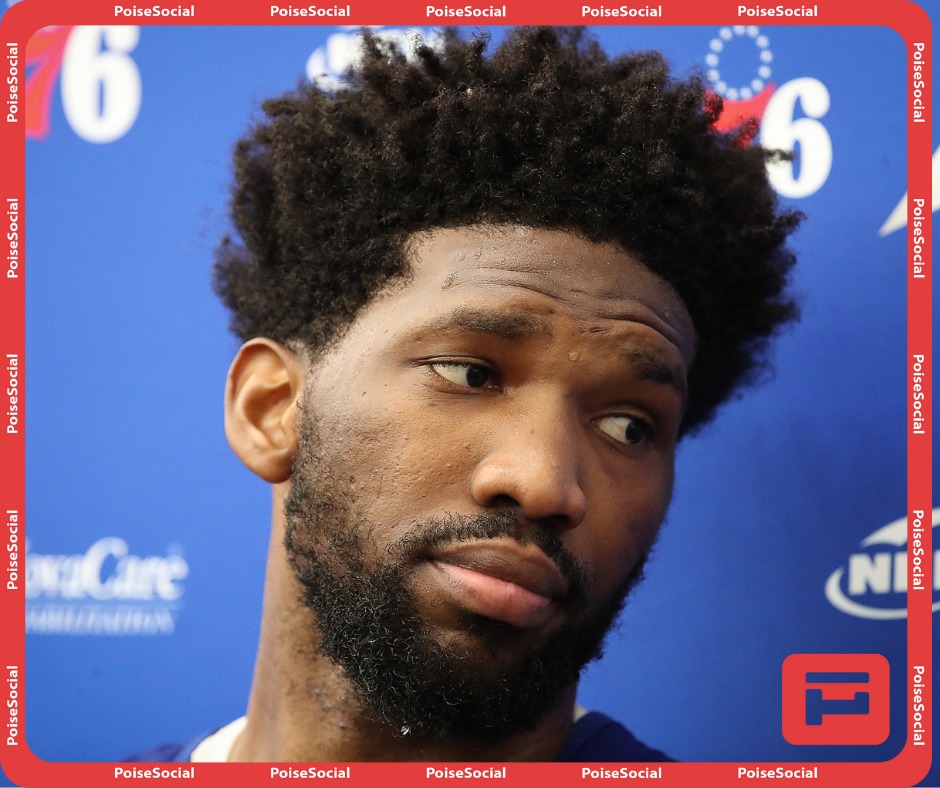

Cameroon’s social media space has been aflame for the last 2 days over reports from French sports outlets that Joel Embiid has taken administrative steps to obtain French nationality, in a bid to play international basketball for the French national team.
The news comes as a very surprising one, as Joel has no connection to France, other than coming from a country that suffers from its neo-colonialist proclivities and speaking its language. Joel has never lived in France either. So what justifies this choice?
No doubt, it is this particular choice of country that has rammed a knife into the neck of Cameroonians and has caused the online ruckus over the issue. Cameroonians generally hold anti-French sentiments, and Joel Embiid’s choice has thrown oil on the fire, and many have made their opinions known, some with barely veiled insults.
It is, however, important to seek a balanced view of the matter by perhaps playing devil’s advocate to see what thought process Joel might have gone through to make that choice, and to juxtapose that with the dispensation in Cameroon today.
Many may not know, but the NBA is very protective of its players. NBA players earn the highest average salaries among all athletes in the world. It is a billion-dollar industry that generated $8.76 billion in 2019. The average NBA franchise alone is worth $2.6 billion today. America, being the capitalist nation that it is, will do everything it can to keep the show going and ensure that its best players are protected, in good shape, and always available to play, irrespective of the calendars of competitions outside the USA. And so, to ensure all this, the NBA includes clauses in its player contracts that ensure it always happens.
Some clauses state that the player will not play for any entity outside the NBA while they have a valid contract, while other clauses require national federations to provide health insurance guarantees before the NBA permits the player to play for the national team. In 2011, for example, the NBA requested that the French federation pay $1.5 million as a health insurance guarantee to release the players the federation sought to participate in the European Basketball Cup. The French team had to negotiate first and then pay 450,000 euros to an insurer that agreed to assume the risk of injury to any French player playing in the NBA.
When we return to Cameroon and review our federations, the only federation capable of paying such an amount is the football federation. Fortunately for them, the national team regularly competes in international tournaments, so the coffers have a strong revenue stream.
The basketball league, on the other hand, is in dire straits, and even with competitions like Afrobasket, the winning nation gets $1 million. Whereas, in football, the Indomitable Lions will receive $1.5 million ahead of the World Cup, just for their preparation. Asking them to shell out 450,000 euros is suicide. And before you ask, it is not the duty of Joel or any other NBA basketballer to help with that, even though they earn millions of dollars every year.
So when you put that into perspective for someone like Joel Embiid, who wants to play international basketball, you begin to understand how financial constraints alone are a major barrier. And we have not even mentioned the amateurism that has plagued the basketball federation for years – amateurism which is sometimes caused by a lack of funding and bureaucrats siphoning money to line their pockets.
But then again, one can ask: What value will France add to Joel Embiid?
Fans of the sport will tell you that there is no greater place, no greater arena to play in than in the NBA. Why would Joel Embiid want to create angst in his countrymen by playing for a country with which Cameroonians share a very troubling past and present? Why do you need to dance with the enemy when you can just be in the NBA and still be considered one of the greatest players of the sport? Clearly, Cameroonians would not have had this kind of reaction if he had chosen to play with the USA.
When viewed from that angle, one begins to understand why Cameroonians are unhappy with his choice and believe that, despite it all, he could have chosen to play for Cameroon. It has not helped that over the last few years, Joel has been accused by Cameroonian fans of the NBA of not being liked to be associated with Cameroon and has never been really proud to say he is from here, except when it is for marketing purposes, like with the release of his shoes tinged with the colours of the Cameroon flag. Some fans have complained that he doesn’t acknowledge them when they go to his games, holding Cameroon flags and calling him by name.
Pascal Siakam, on the other hand, seems far more beloved and elicits greater empathy from Cameroonians. It gets worse when the fact that the efforts of another Cameroonian NBA player, Luc Mbah A Moute, were instrumental in making Embiid who he is today. It is no secret that Joel Embiid was scouted at one of the basketball camps organized by the former, who took Joel to the States and coached him on integrating into society, ultimately helping him land a spot in the NBA.
But ultimately the onus of responsibility no doubt lies on the government and its responsibility with the many dispirited youths its poor governance has left in its wake. There is no real, tangible politics and policy with regard to the development of sports in Cameroon. OSSUCS and FENASCO are relics of their past, and football, which is the one tree that tried to cover the burnt forest of sports has itself been plagued by mismanagement for donkey years. Eto’o’s ascension to power at the Fecafoot is the one beacon of hope that could keep that tree alive as well as the little saplings it will hopefully, soon bear.
Even Francis Ngannou’s performances in the UFC, which President Paul Biya ironically asked youths to emulate, are indirectly the result of his poor governance. Ngannou, in Cameroon, would never have been equipped with the tools and advocacy he needed to become the fighter he is today. And he is the person these same bureaucrats, who have starved the country, are showing to the youth as a model of success.
Rwanda, for example, has been making significant efforts in the development and marketing of sports, particularly basketball. Much more than the Cameroonian government is doing regarding the marketing and promotion of sports.
Sports do not develop a nation, but the development of sports can instill in young people the drive, discipline, and hard work it takes to be successful. And for those who succeed in football, basketball, swimming, track and field, etc., they give their younger ones the opportunity to dream and aspire to be like them. Just like how Thomas Nkono made Carlos Kameni dream, and like how, in turn, Kameni made Andre Onana dream.
The USA gave Embiid everything he needed to succeed. So long as we do not give our youth everything they need to help them dream and succeed, France and the other countries to which they will forfeit their nationalities will continue to be our wall of lamentation.