

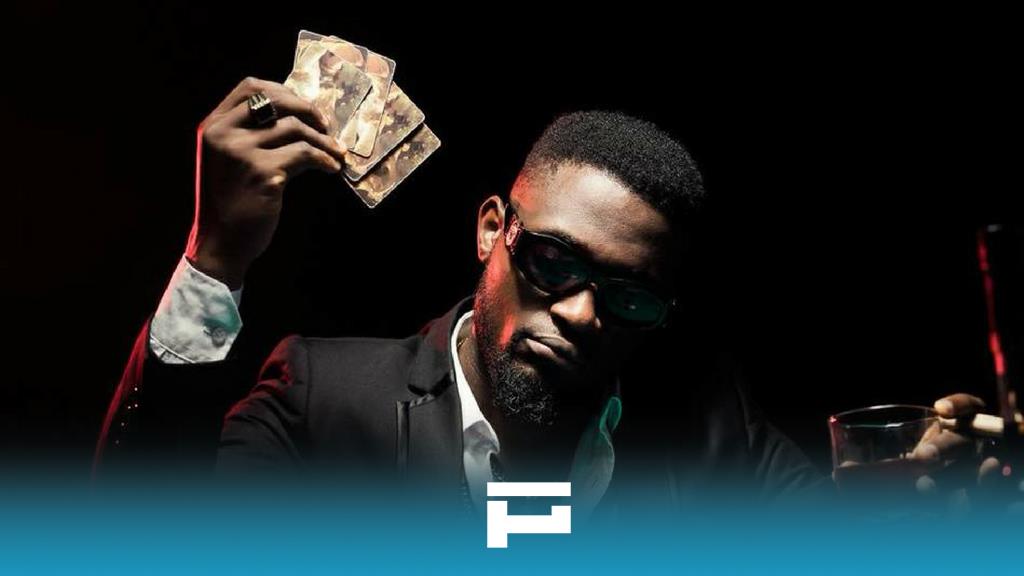
Salatiel after the Afrima facebook post saga has been an interesting one to watch. Straight unapologetic about his achievements, we have seen him flaunting his 25 Million music studio, his washing machine, his sunkissed and branded record label mini-van, Alpha Better flip flops etc. You feel it is the moment he has been waiting for. As I write, it appears Salatiel is in Germany. On his facebook he has posted pictures of some of his recent purchases - a guitar and some music production sound bundles with prices in the millions.
In Cameroon, and I would assume in most parts of the world, you have to either negotiate your way to the top of the music food chain, or create your way to the spotlight. No matter how much we’d love to see everyone all buddy buddy, the music industry is not a nursery school football game. Nobody cares if you just started yesterday, they comparing your first video to Davido’s latest video.
I think we are past the stage where I need to remind you of the difference between the music and the music business. In the past, I have written to the disagreement of many that the artists that will survive in this game are those that actually produce their own music. I want to extend that to say the artists that will last the journey are those who understand this simple accounting equation; Assets - Liabilities = Equity. This is the big picture of what I was trying to say in that article.
I think more are more people are coming to the realization that the systems created during the industrial revolution to organize society are no longer sustainable and are on the brink of total collapse. We have failing pension programs and systems of production that make most university degrees near useless. The result is the rise in entrepreneurship around the world. The effects of which can also be felt in the music industry as we continue to see the rise of the independent artists over label backed acts.
The biggest flaw in our education system is that it does not teach us any much about money. It is designed to create employees trained to perform specific tasks that do not necessarily require them to understand the concept of creating wealth so they can dedicate their lives creating wealth for their employers while remaining in a financially brittle situation which scares them into following the rules and doing meaningless work that they hate.
Davido reminds us in one of his songs that “Life is all about the money.” So I ask myself why financial education is not given any much attention in our educational system. If you have read the famous book by Robert Kiyosaki Titled ‘Rich Dad Poor Dad’, this will resonate better with you. If you have not, I still think it is a must read.
That said, Salatiel seems to me to be one of few artists in Cameroon making sound financial decisions. Most artists when they first start making some money focus on upgrading their lifestyle and in the process, they pick up more Liabilities at the expense of assets which are the stuff that actually make you money. I do not care whether you are a producer or not. As an artists, if you do not have at least a home studio, you have not business buying a car.
One of the lessons in Robert Kiyosaki’s book is:- 'The rich focus on their asset columns while everyone else focuses on their income statements.'
Basically, while average people are busy concerning themselves with their hourly pay, rich or would be rich people are focusing on their assets and net worth.
We all need to start acquiring assets - things that put money in your pocket— rather than liabilities, things that take money out of your pocket. Assets are things like stocks, bonds, your own company, and intellectual property, while liabilities include mortgages, consumer loans, and credit cards.
"The long-term rich build their asset column first," Kiyosaki writes. "Then the income generated from the asset column buys their luxuries. The poor and middle class buy luxuries with their own sweat, blood, and children's inheritance."
I have a friend who is into metal works and he confessed to me that his business has not grown much since he took money he could have reinvested into his business by buying more equipment and instead decided to go and build a house thinking the security of having your own home would be good for business. Most people may confuse a house for an asset but it is actually a liability. A house does not generate you any income unless. what it actually does is take money from your pockets because it needs to be equipped and maintained.
In Rich Dad Poor Dad, we also learn that 'It's not the smart who get ahead, but the bold.' - Taking money that you could do something comfortable like building a house and investing it in a business that might fail is something only the bold will do. Rich people play to win, which, much like having your money work for you, requires an element of risk-taking and comfort with uncertainty. As important as it is to take risks to accumulate wealth, it's equally important to be smart about risk-taking, which is why Kiyosaki emphasizes "managing" risk. Blind risk won't get you anywhere, but intelligent risk is the mother of reward.
Another lesson from Rich dad Poor Dad is :- ’The poor and the middle class work for money. The rich have money work for them.' Kiyosaki isn't the only one to point out that there is a difference between how rich people and average people choose to get paid. Average people choose to get paid based on time — on a steady salary or hourly rate — while rich people generally own their own businesses, work on commission, or choose stock options and profit sharing over higher salaries.
"If you work for money, you give the power to your employer," Kiyosaki writes. "If money works for you, you keep the power and control it." Working for money is the easier path — it's what we're taught in school (how to write a résumé, get a job, and work hard). Having your money work for you — by starting a company, being your own boss, or investing — requires calculated risk and a level of comfort with uncertainty.
So how do you make money work for you? - That has already been answered but for those who have not gotten it yet, you do that by acquiring ASSETS.
My work life makes is that I am hardly in any city for very long. I once spent four months without sleeping in an apartment for which I was paying rent.
Our culture would see renting your own apartment as a sign of maturity and independence but are those really going to make you wealthy in the long run as an entrepreneur? - For me renting an apartment just to feel big does not make any sense.Once my apartment turned from an asset to a liability, it had to go. So I decided that since I am still always a child to some people, I would lose the apartment, take the L on being ‘the man’ and move back in with my family until getting an apartment becomes an asset.
Im currently making the move to getting my own apartment which is going to house my music studio and also double as a workspace for PoiseSocial employees. That means the apartment should be directly involved in generating money for the rents. Imagine the savings on rents I have made since I moved back to live with my uncle, not to talk about all the free food and no bills.
I have a friend who is a photographer and his apartment is also his photo studio- thereby turning what could have otherwise been a liability into an asset. The same guy has a car which many buy as a luxury but for him, it is really an asset. First of all, it is big enough to carry all his equipment which means he will never have to rent a car to transport his equipment. Technically, whenever he has to work out of his studio, he rents his own car and pays himself to carry his equipment.
I have another friend who is a fashion designer. He has invested some money in getting a basic DSLR Camera. He is not a professional photographer but there are times he needs photos of his products on a fly and it makes no sense paying a professional photographer all the time, at least at his level. Now he might not have the skills to get the best photos out of his camera but he can learn the basics and always get some good quality shots that a cell phone cannot produce. Two weeks ago, I had a job and I rented his Camera for 6 days at 15,000 FCFA a day. Thats 90,000 FCFA. The Camera I got from him costs about $500 brand new, approximately 250,000 FCFA. You see he only has to rent that Camera 3 times to someone like me to make back all his money and still be in possession of a Camera. You also see I did not beg him for his Camera because he is my friend. I paid for it but that is a lesson for another day.
Another person with the money would prefer to buy a fancy sports car that can’t carry all his equipment or even go to some places with bad roads. Which means every time they need to work and have to carry many people and equipment, they have to rent a van and give someone else some of the money they would have kept. If Alpha Better has to perform in Yaounde, they can carry their entire team in their van, travel at their convenience for less that half of what it would cost to transport their team comfortably via public transport and still save money on moving around in Yaounde.
Salatiel is in the business of music production and we see him constantly upgrading his studio and increasing his chances of making better music and thus getting paid more. Many would claim it is not about the tools but about how you use them but that only holds true when everyone has the same tools. In music production, especially in pop music, getting the hit record usually boils down to the sound of the time and most of the time, it is easier for you to just buy the soundbanks than spend time learning about sound design to be able to create your own sounds and replicate any sounds that might be of the time.
I know entrepreneurs who after getting their first big check, have gone out to rent expensive apartments and hung flat screen TV’s on the walls in every room.All that in addition to the office space they are already renting - the kind of financial decisions that 9 out of 10 times will prove to be disastrous in the long run.
Any-Ha!
I would love for you to take the time out right now and draw a table with two columns. Write down your assets on one column and liabilities on the other and do the math for yourself so you can see where you stand. I did that and it helped me make better decisions. I am not there yet but it has been much better. In August last year, I spent about 350,000 Francs to buy some audiovisual production equipment and since then, I would have made almost 2 million francs (If Cameroonian paid what they agreed to pay) from jobs that I could confidently bid for because I had the equipment to be able to deliver. At the time, it was either buy those equipment or get myself some new sneakers for the gram. In the past, at that very crossroad, I have made the wrong choice but not again.
I famously said about Cameroonian artists that they “work on their hair before they work on their music.” I was trying to draw the distinction between focusing on assets and liabilities. And yes, just said, a hair do is a liability unless you are a vendeuse de piment. They say looking good is good business but if you really think about it, good business is the best way of looking good. If you doubt me, ask Dr Nkeng.
I was at my friends Studio and an artist came in for a photoshoot. When I asked to listen to their music, they said they had not yet recorded anything -Talk about priorities.
- Tino Foy