

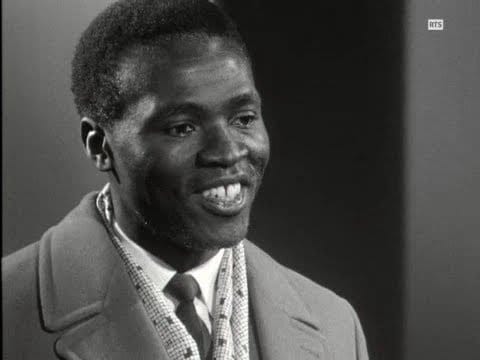
On this day, 15th January, in 1971, Ernest Ouandie was executed publicly in Bafoussam. He had been sentenced to death on January 5th, 1971 and had refused to ask for presidential grace from President Ahmadou Ahidjo.
Ernest Ouandie was born in Badoumla in 1924. He attended school in Bafoussam and Yaounde and began working as a teacher in 1943, teaching in Edea, Dschang, and Douala. In 1944, he joined the union of trade unions in Cameroon, the first step to his political militancy. In 1948, he joined the UPC and was elected its VP four years later.
When the UPC was dissolved and outlawed in 1955, many of the militants fled into hiding. While Um Nyobe hid in the forest around his hometown of Boumnyebel, Ernest Ouandie fled to Kumba in 1956. The British government deported him, Marthe Moumie (remember her?) and 9 others to Sudan. After which they went into exile in Cairo and then Guinea. Guinea had just gained independence and president Sekou Toure was anti-French. After Guinea, they went to Ghana.
Meanwhile, at home, the fierce fighting continued between the UPC and French forces. Um Nyobe was captured and killed in 1958, and Felix Moumie was poisoned by a French spy in Geneva in 1960. Ahidjo got help from France which sent French troops to “pacify” the Bamileke region where most of the UPC militants had gone into the ‘maquis.’ Under Gen Max Briand the French soldiers basically carried out a genocide, killing hundreds of thousands of innocent Bamileke whom they suspected to be ‘maquisards’ or aiding them.
Ernest Ouandie was judged in absentia and proclaimed "Enemy Number One". He however secretly returned to Cameroon in 1961 to lead the armed struggle against Ahidjo whom he had plans to overthrow. It was a ruthless war. Scores of UPC guerrilla fighters were captured and executed summarily. In January 1964, public executions of fifteen captured rebels were staged in Douala, Bafoussam, and Edéa as part of the celebrations of the fourth anniversary of independence.
The Western region lived to the sound of gunshots and many fled. There was also some power tussle between the other UPC militants in exile that led to a lot of disorganisation among the ground forces fighting the government.
Bishop Albert Ndogmo, Bishop of Nkonsgsamba (we’ll talk about him some other day) had been asked by President Ahidjo to help mediate with the UPC rebels and had had some meeting with them. It would seem however that he sympathised with them. In mid-1970, Ouandie called for help from the Bishop and the Bishop personally picked up Ouandie and his secretary in his car and drove him to his house. A few days later, he was called to Rome and asked his catechist to take care of the two rebels. The catechist instead alerted the police after the Bishop had left.
Ouandie and his secretary ran away, but since they were in unfamiliar territory and were hunted by police as well as locals they got lost. He and his secretary parted ways after disagreeing over directions and on August 19, 1970, he found himself around the town of Loum.
Tired, exhausted, hungry and disoriented, he saw a passer-by and asked for help. The man recognised Ouandie and took him towards the gendarmerie office. Ouandie himself recognised that it was a gendarmerie and asked the man to let him be. Probably feeling very tired of everything, he walked to the gendarmerie and told the gendarmes there who he was. Upon hearing this, the gendarmes panicked and fled (don’t ask me why) but later came back. A helicopter came for him and took him to Yaounde where he was imprisoned.
5 months later, he was executed publicly. He was asked if he wanted to be blindfolded and he refused, saying he wanted to look at death in the face. He was 46 years old.
#PoiseHistory