

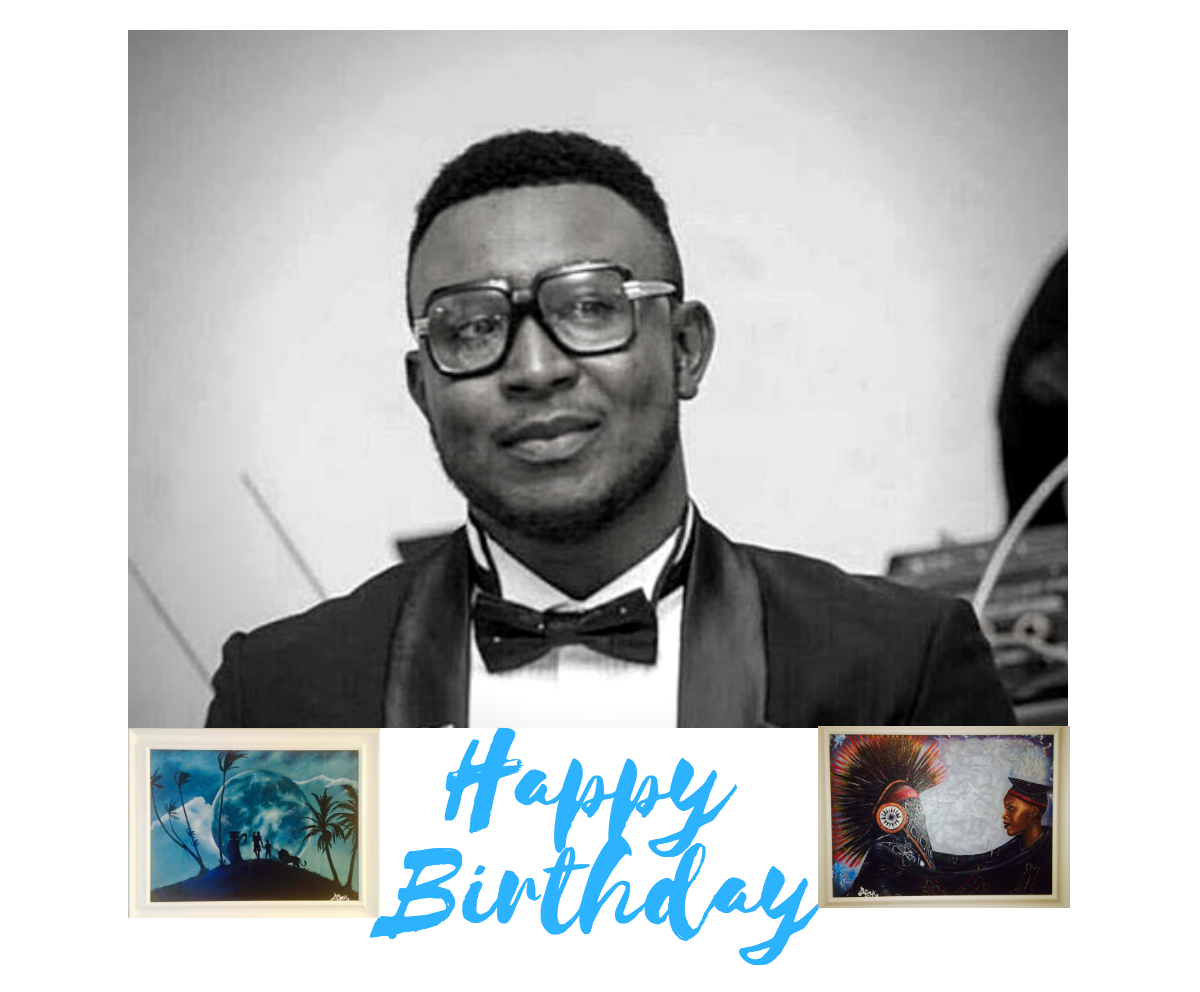
artTIST CRORNER: HAPPY BIRTHDAY ASEK AND A FEW ART LESSONS!
Ndedi Asek is one of the more known budding artists of our generation. Majority of his work consists of figurative and portrait oil paintings. His figurative work is socially conscious and inspired mainly by African cultures and societies.
Asek has also lent his talent to the music industry, working on cover artwork for artists like Yung Time and Gasha!
Happy Birthday Asek. Guess more grease to your elbows is in order.
Let us take this opportunity to learn a little bit more about Asek's genre of art (painting) by looking at 7 major painting styles.
1. REALISM:
Realism is the art style most people regard as "real art," where the subject of the painting looks very much like the real thing, rather than being stylized or abstracted. Only when examined up close will what appear to be solid color reveal itself as a series of brushstrokes of many colors and hues.
Realism has been the dominant style of painting since the Renaissance. The artist uses perspective to create an illusion of space and depth, setting the composition and lighting such that the subject appears real. Leonardo da Vinci's portrait of the Mona Lisa is a classic example of realism
2. PAINTERLY
Liberated by the invention of the metal paint tube, which allowed artists to step outside the studio, painters began to focus on painting itself. Subjects were rendered realistically, but painters made no effort to hide their technical work.
As its name suggests, the emphasis is on the act of painting itself: the character of the brushwork and pigments themselves. Artists working in this style do not try to hide what was used to create the painting by smoothing out any texture or marks left in the paint by a brush or other tool such as a palette knife.
3. IMPRESSIONISM
Impressionism emerged in the 1880s in Europe, where artists like Claude Monet sought to capture light not through the detail of realism but with gesture and illusion. You don't need to get too close to Monet's water lilies or Vincent Van Gogh's sunflowers to see the bold strokes of color.
And yet there's no doubt of what you're looking at. Objects retain their realistic appearance, yet have a vibrancy about them that's unique to this style. When the Impressionists were first showing their works, most critics hated and ridiculed it. What was then regarded as an unfinished and rough painting style is now loved.
4. EXPRESSIONISM AND FAUVISM
Expressionism and Fauvism are two similar styles that began to appear in studios and galleries at the turn of the 20th century. Both are characterized by their use of bold, unrealistic colors chosen not to depict life as it is but as it feels or appears to the artist.
5. ABSTRACTION
As the first decades of the 20th century unfolded in Europe and in America, painting grew less realistic. Abstraction is about painting the essence of a subject as the artist interprets it, rather than the visible details.
A painter may reduce the subject to its dominant colors, shapes, or patterns, as Pablo Picasso did with his famous mural of three musicians. The performers, all sharp lines, and angles don't look the least bit real, yet there's no doubt of who they are.
6. ABSTRACT
Purely abstract work, like much of the Abstract Expressionist movement of the 1950s, doesn't try to look like anything realistic. It is the ultimate rejection of realism and the complete embrace of the subjective. The subject or point of the painting is the colors used, the textures in the artwork, the materials used to create it.
7. PHOTOREALISM
Photorealism developed in the late 1960s and '70s in reaction to Abstract Expressionism, which had dominated art since the 1940s. It is a style that often seems more real than reality, where no detail is left out, and no flaw is insignificant.
Some artists copy photographs by projecting them onto a canvas in order to accurately capture precise details. Others do it freehand or use a grid system to enlarge a print or photo.
----------------------------------------------------
Under what category would you place Asek on this list?
- TeamPoise - Additional Content from ThoughtCo